Compact laminate vs laminate: what is the difference?
The surface is the same hard laminate, but laminate is a thin layer glued to a wood-based board, while compact laminate is laminate all the way through. The difference shows when water reaches an edge.
- Laminate
- Thin layer glued to chipboard or MDF
- Compact laminate
- Laminate all the way through
- Melamine
- One layer pressed directly onto the chipboard
- Water
- The core board swells at the edge, compact laminate does not
- Edges
- Edge banding or a visible core
- Thickness
- Thinner for cubicles, thicker for wash counters
Compact laminate or laminate is a choice that comes up again and again in specifications for built-in furniture in schools and institutions. The surface looks the same and feels the same, so the difference lies underneath. Laminate is a thin layer glued onto a core board of chipboard or MDF. Compact laminate is the same material pressed into a board that is laminate all the way through. That decides where each of them can be used.
How the boards are built
Laminate, or HPL for high-pressure laminate, is made from layers of paper soaked in resin and pressed together under high pressure and heat. The top layer carries the colour or decor. As the surface of a piece of furniture, the laminate is thin and glued to a core board, and the edges are closed with edge banding.
Melamine looks similar but is something else. Here a single layer of resin-impregnated paper is pressed directly onto the chipboard. It is cheaper than laminate and takes less wear and fewer knocks, and it is the white surface most people know from cabinets and shelves.
Compact laminate is laminate in full thickness. There are so many layers of paper and resin that the board becomes solid and can carry itself. The core is usually black and shows as a stripe on the edge, and boards with a coloured core are available.
What happens when water reaches the edge
The surface is tight on both boards. It is the edge that makes the difference. On laminate on a core board, the edge is edge banding glued to chipboard or MDF, and every hole for a hinge or a pipe goes through the laminate and into the wood. If water stands at an edge or in a hole, the core board soaks it up. Chipboard and MDF swell when they get wet, and they do not shrink back when they dry again. The edge banding comes loose, and the furniture has to be replaced.
Moisture-resistant chipboard and MDF last longer in damp rooms, but they are still wood, and if they stand in water, they are damaged.
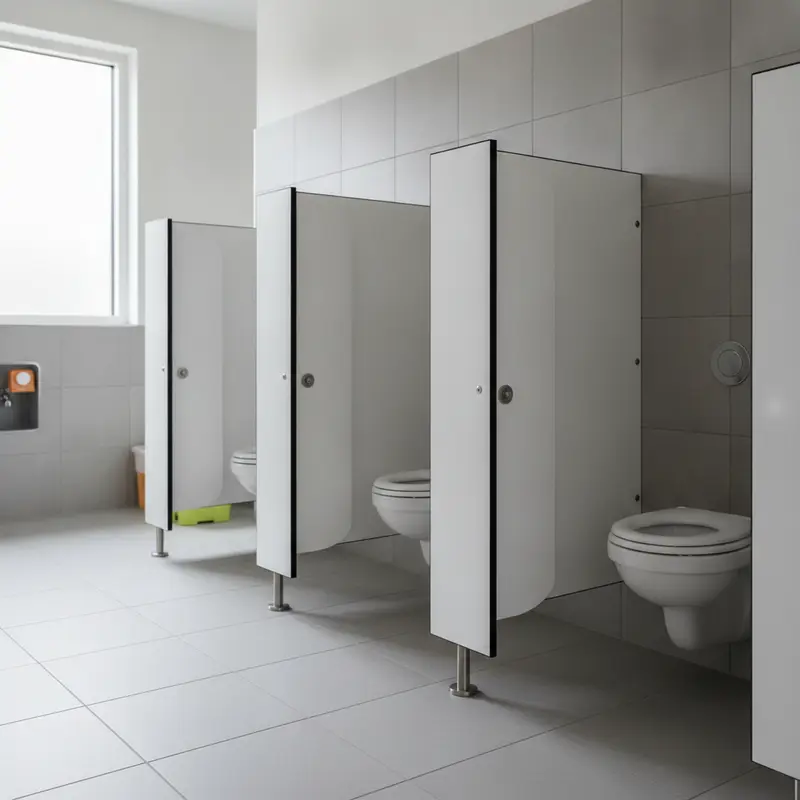
Compact laminate has no core that can soak up water. An edge or a drilled hole is the same dense material as the surface, so the board can stand in a room where there is water on the floor and where the furniture is washed down every day.
Where each of them belongs
| Property | Laminate on a core board | Compact laminate |
|---|---|---|
| Build-up | Thin laminate glued to chipboard or MDF | Laminate all the way through |
| Edges | Closed with edge banding | Sanded and left visible with the core |
| Water | Takes water on the surface, not in edges and holes | Takes water everywhere |
| Self-supporting | No, sits in a piece of furniture | Yes, e.g. as a partition on legs |
| Weight | Like the core board | Heavier than a wood-based board |
| Price | Cheapest | More expensive |
Laminate on a core board is a good and cheaper choice for cabinets and fronts in dry rooms, such as classrooms and offices. Compact laminate belongs where water hits the furniture, in toilets and changing rooms. Read about toilet cubicles and cabinets in compact laminate.
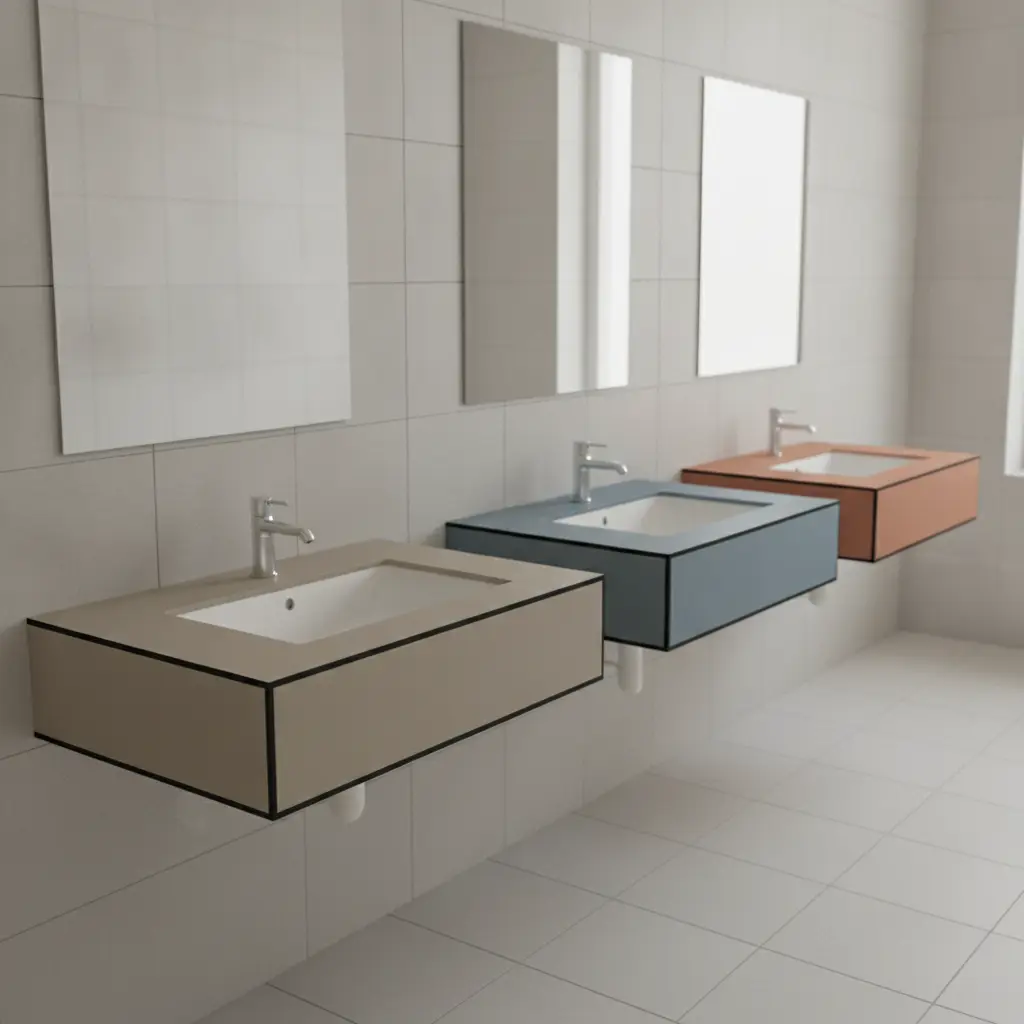
Between the two are rooms that are damp without being wet, such as a staff kitchen. Here the cabinets can be laminate on a core board, while the worktop around the sink is compact laminate. That is often where the money is best spent.
Thickness and machining
The thickness is chosen by what the board has to carry and how far it spans. Partitions and doors in toilet cubicles are typically made of compact laminate of 12 to 13 mm. A wash counter that has to carry a basin and span freely between the brackets is made from a thicker board, e.g. 20 mm.
Compact laminate is heavy and hard, so it is cut and drilled with carbide tools, and it takes longer to machine than a wood-based board. The edges do not need to be closed. They are sanded and chamfered, so the core becomes part of the look. See what we build in compact laminate.
Maintenance
Both surfaces are cleaned with water and ordinary cleaning agents, and neither needs oiling or painting. A deep scratch cannot be sanded away, as it can on oiled wood. If the furniture is mostly worn by knocks and bumps, oiled plywood can therefore be a better choice, because the surface can be refreshed on site. See plywood, MDF or chipboard.