Do you need to prime plywood?
Yes, if the plywood is to be painted. No, if it is to be oiled, because the oil has to get into the wood, and a primer would close it off.
- To be painted
- Yes, sand and prime first
- To be oiled
- No, the oil is the treatment
- To be lacquered
- The first coat of lacquer acts as primer
- The edge
- Absorbs most and gets an extra coat
- Knots in pine
- Stain-blocking primer under light paint
- Water
- Compact laminate instead of plywood
Whether plywood needs priming depends on what goes on top. If it is to be painted, yes. If it is to be oiled, no, and if it is to be lacquered, the first coat of lacquer is the primer itself. What all three treatments have to allow for is that plywood absorbs unevenly.
Plywood is thin layers of wood glued together with the grain running crosswise, and only the outer layer is visible. In pine, the light, soft parts of the growth rings absorb more than the dark, hard ones, so the surface takes paint and colour differently. The edge absorbs most, because every other layer shows end grain, and end grain draws liquid further in than the rest of the wood.
That is why paint on untreated plywood often turns out blotchy, and a coloured oil tends to go darker on the edge than on the face.
If it is to be painted: sand, prime and paint
Plywood that is to be painted is sanded first, so the surface is clean and even. Then it is primed with a wood primer that seals the surface, so the paint lies evenly. A water-based primer raises the wood fibres, so the surface is lightly sanded before painting. Two coats of paint is normal.
On pine plywood, the knots can bleed through a light paint as yellow stains. Here a stain-blocking primer is used that holds back the resin in the knot. The edge gets an extra coat of primer, and if it has to be smooth under the paint, it is filled first, so the layers cannot be seen.
If the furniture has to be painted and completely smooth, MDF is often a better starting point than plywood. See the guide plywood, MDF or chipboard.
If it is to be oiled: no primer
Oil has to penetrate the wood and cure there. A primer would close the surface so the oil cannot get in, so it is skipped. The oil is applied in a thin coat, and whatever the wood does not take is wiped off before it cures, so no oil is left standing on the surface.
The advantage shows when the furniture is worn. A worn corner or a scratch is lightly sanded and oiled where the damage is, without the whole surface having to be treated again. That is why oil is our starting point for plywood furniture for schools and institutions.
Colour: stain or coloured oil
Stain colours the wood but does not protect it, so a stained surface needs oil or lacquer on top. Coloured oil gives colour and protection in the same treatment, and the grain shows through the colour.
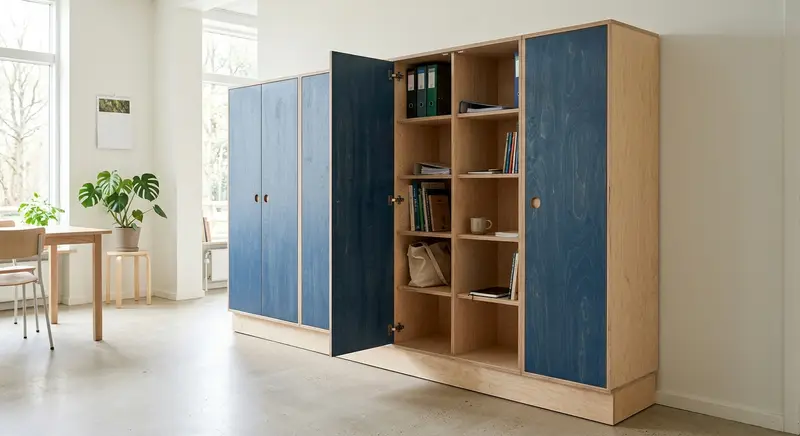
The same colour looks different on pine and birch and can vary from board to board, because the wood absorbs differently. That is why the colour should be approved on a sample of the board the furniture will be made from. On a cabinet, the doors can be coloured while the rest stays in clear oil, see plywood cabinets.
If it is to be lacquered: the first coat is the primer
Lacquer lays a film on top of the wood. The first coat acts as a sealer: it closes the surface and raises the fibres, so it is lightly sanded before the next coats are applied. A lacquered surface is closed and easy to wipe. If a scratch goes through the film, moisture and dirt can get in underneath, and if the repair must not show, the whole surface has to be sanded and lacquered again.
Our starting point is oil, but if the joinery specification says lacquer, lacquer is what we price and deliver.
No treatment makes plywood waterproof
Oil and lacquer protect against moisture from wet jackets and a cloth, but they do not turn plywood into a wet-room board. There is plywood glued with waterproof glue, but the wood in the layers still soaks up water if it stands on the surface or draws into the edge. Where water hits directly, as in toilets and at wash counters, we use compact laminate, which is laminate all the way through and needs no treatment.