Plywood vs MDF vs chipboard for built-in furniture
The three boards look the same on a drawing, but they behave differently once the furniture is in use. Here is what is inside each board, and when MDF or chipboard is the right choice rather than plywood.
- Plywood
- Holds screws and takes knocks, the edge can stay visible
- MDF
- Smooth surface for paint and routed shapes
- Chipboard
- Cheapest, for cabinets in dry rooms
- Weak point
- MDF and chipboard are vulnerable at the edge
- Water
- None of the three, use compact laminate
- Certification
- Clarify FSC, PEFC and Nordic Swan early
Plywood, MDF or chipboard for built-in furniture? For furniture that takes knocks and has to last for many years, plywood is usually right. MDF is right where the surface has to be painted completely smooth or routed into a shape, and melamine-faced chipboard is right for cabinets in dry rooms, where price counts most. The difference lies in what the boards are made of.
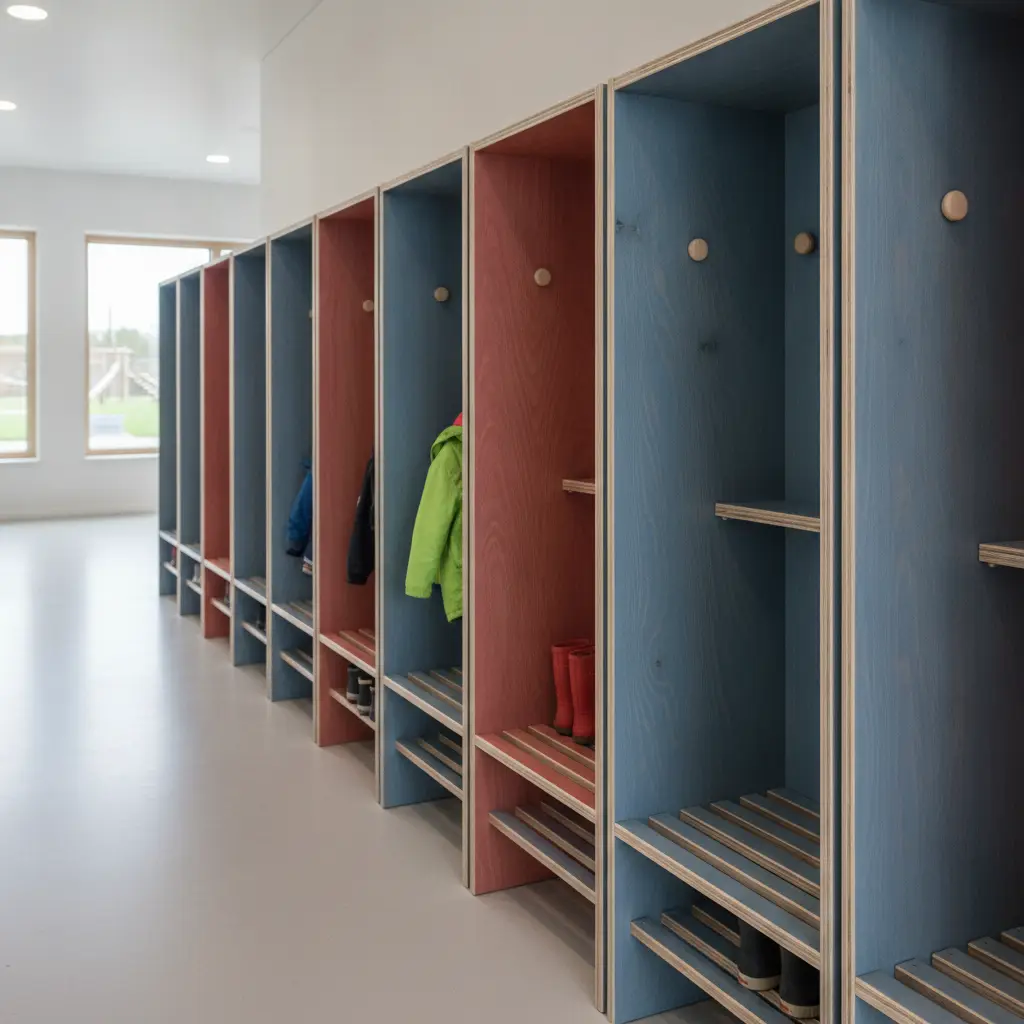
Plywood is thin layers of wood glued together with the grain running crosswise. Each layer holds the next, so the board moves far less than solid wood and is strong for its weight. The edge shows the layers as stripes.
MDF is wood fibres pressed together with glue into a dense board with no grain and no layers. It is the same all the way through, so it can be routed into soft shapes and painted without anything showing through.
Chipboard is wood chips pressed together with glue. It is stiff enough for a cabinet and the cheapest of the three, but the chips are coarse, so the board almost always gets a melamine or laminate face and edge banding.
| Property | Plywood | MDF | Chipboard |
|---|---|---|---|
| Screws in the edge | Hold well | Can split the board | Hold worst |
| The edge | Can be left visible | Painted or covered | Covered with edge banding |
| Surface | Oil, lacquer or laminate | Paint or veneer | Melamine or laminate |
| Moisture | Takes moisture, not standing water | Swells, available in moisture-resistant grade | Swells if water reaches the edge |
| Knocks and wear | Can be lightly sanded and oiled | The paint can be touched up | A chip cannot be sanded out |
| Board price | Highest | In the middle | Lowest |
When MDF is the right choice
MDF is right when the surface has to be painted and completely even, e.g. fronts in the same colour as the wall, or when a panel has to be routed into a shape with soft edges. Because the board has no grain, the paint looks the same across the whole surface, and a routed edge comes out smooth. Plywood can also be painted, but the grain can be seen, and the edge has to be filled if the layers must not show. How plywood is painted is explained in the guide do you need to prime plywood?
The weakness is the edge. A screw straight into the edge of MDF can split the board, so joints in the edge are pre-drilled or made with fittings designed for MDF. Ordinary MDF does not take moisture and swells if water gets in, but there are moisture-resistant grades for damp rooms.
When chipboard is the right choice
Melamine-faced chipboard is right for cabinets that stand in a dry room behind closed doors, such as a storage cabinet or an office cabinet. The melamine is smooth and easy to wipe, and the board is the cheapest way to build many cabinets.
The weakness is here too in the edges. If water gets in under the edge banding, the chips swell, and it cannot be repaired. A knock that chips off a piece of the melamine cannot be sanded out either, and a screw that has come loose grips less well when it is put back in. That is why chipboard is not right for benches and cloakrooms that take knocks every day.
Plywood where furniture is used hard
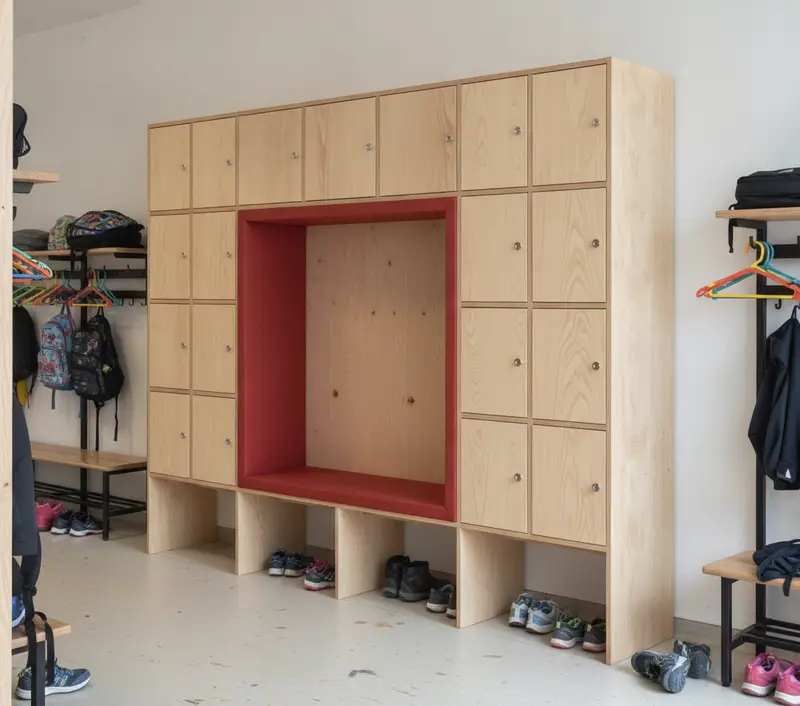
Plywood is right where the furniture takes knocks, and where hinges and hooks have to stay put for many years. The board holds screws, also close to the edge, and the edge can be left visible without edge banding. An oiled surface can be refreshed where it is worn. What that looks like in a school or a daycare centre is shown under plywood furniture.
The boards can also be combined. Both MDF and chipboard can get a surface of real wood, veneer, but the edge still shows the board and has to be covered. A cabinet that stays closed in a dry room can have plywood doors on a melamine carcass. What that means for a cabinet is shown under plywood cabinets.
When water hits
None of the three boards belongs where water hits directly, as in toilets and at wash counters. Here compact laminate is right, because the board is laminate all the way through and does not soak up water. The difference between compact laminate and laminate on a board is explained in the guide compact laminate vs laminate.
Certification and documentation
If the tender requires FSC- or PEFC-certified wood, or if the building is to carry the Nordic Swan Ecolabel, the boards must be documented. It is worth clarifying early, because not every board can be supplied with the certification the tender requires. See furniture for Nordic Swan Ecolabel buildings.